Showing posts with label flyfishing for gar. Show all posts

Monday, January 15, 2024

Gar on Fly

 ***I haven't shared much regarding techniques for quit a while, my recent posts being more about the fish with which I am so enamored.  I'm going to start sharing more specifically what I've learned for the various species I've caught.

We all know fish in different waters can behave differently and have different preferences.  But I think overall this will give folks who want to try for certain species more info that can hopefully get them started off on the right foot, rather than going blindly.  We can all shorten our personal learning curve by first learning from the experience of others.***

This blog post is about Gar.

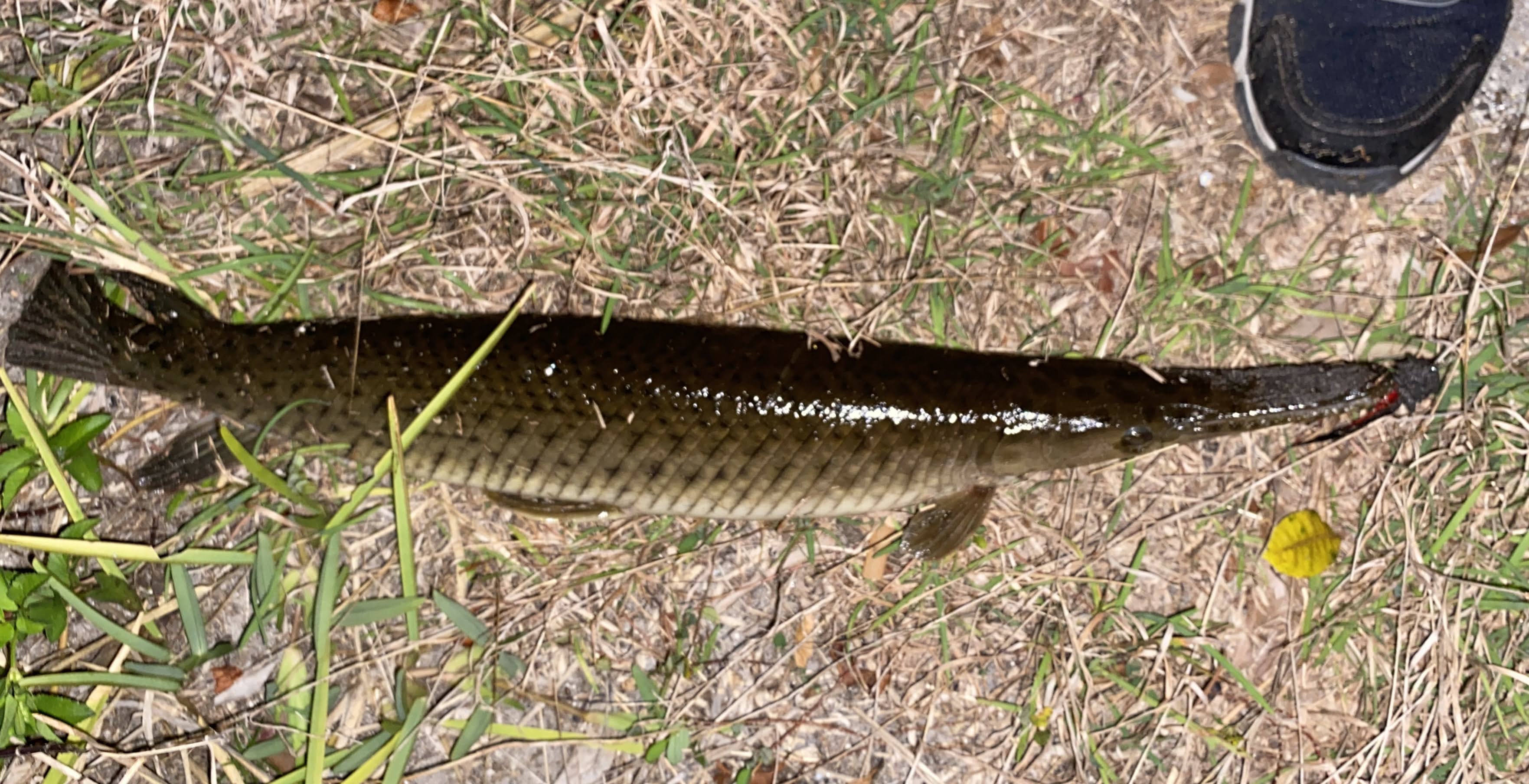
Gar on Fly (here, a 29" Shortnose Gar)

There are 7 species of Gar, 5 of which are located in the United States.  These 5 are Alligator Gar, Longnose Gar, Florida Gar, Spotted Gar, and Shortnose Gar.  I hope to catch Alligator Gar on fly later this year (2024).  This blog post will cover the remaining 4, which I have caught on flies.

Best time of year is definitely during the warmer months.  Once the water temp in my area drops below about 60, the gar seem to completely disappear.

Gar can be found in creeks, streams, rivers, canals, swamps, ponds, lakes, and reservoirs.  They can be in current areas and in stagnant areas.  Gar can breath air, and are often seen gulping air at the surface of the water.
Gar
Like for most flyfishing, good water clarity can help in locating and targeting individual fish.  Below spillways, gar may be in open water areas, but definitely try any current seams and slower eddies.

Gar will feed in the entire water column...from the surface to the bottom.  I like getting them with flies just below the surface...something that sinks very slowly.  If you see fish hanging out at a certain depth, get the fly to that level, or just above.  I have dropped flies past suspended gar, and they will dive down and follow the fly.  They might lose track of a fast-sinking fly, but a slower sinker might get eaten.

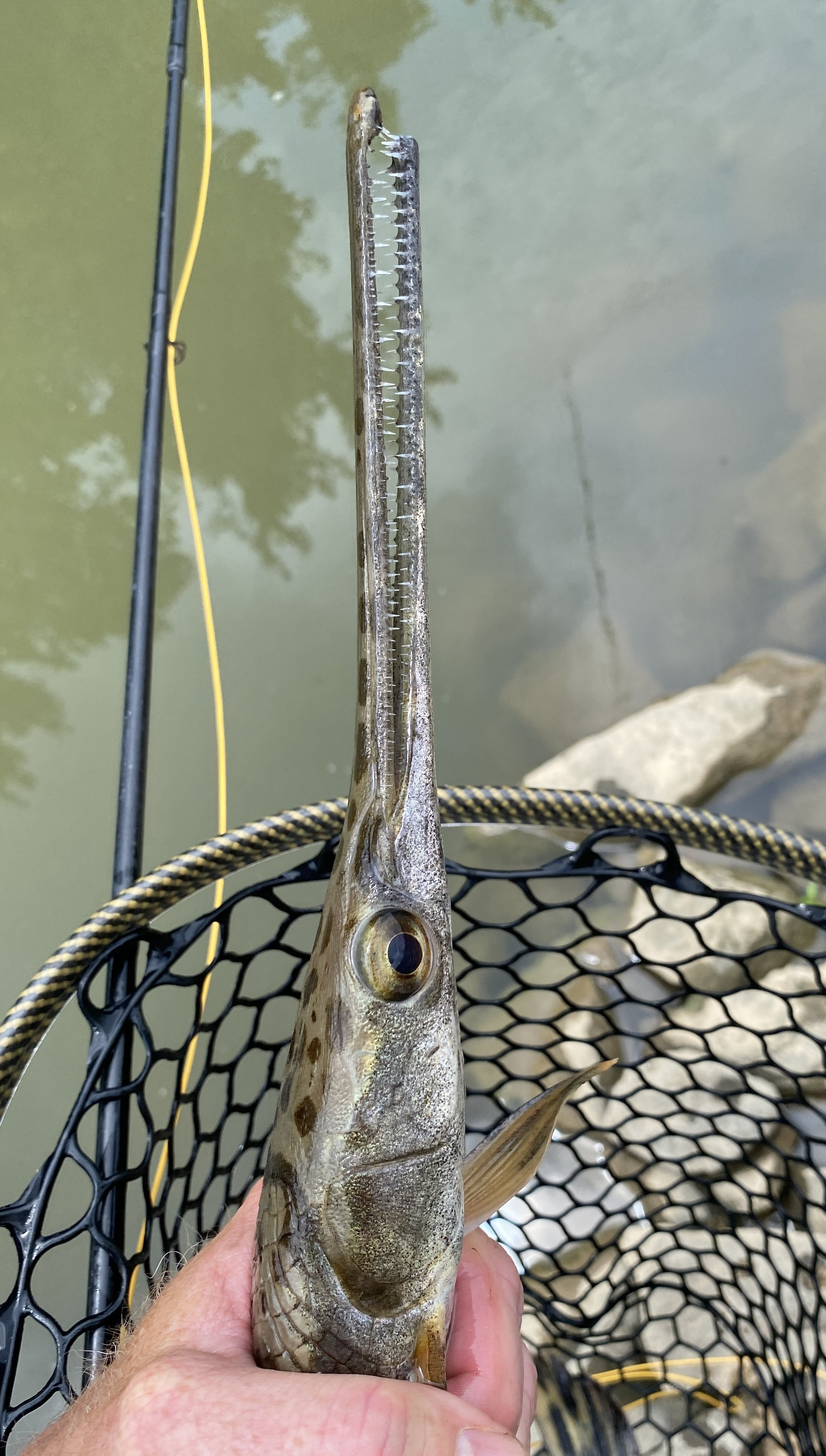
Once you've spotted a gar, cast your fly beyond it, then swim the fly near or over the gar's nose/bill/beak.  Once they spot the fly, they will usually follow it and strike it.  When the fly is inside their mouth, strip-set hard.  It's always a challenge to get the hook point to catch on something in a gar's bony, toothy mouth.  A smaller sharper hook generally has a better chance of catching on something.
Half of a Gar's lower jaw that I found along a river.

Because of the bony mouth, you will miss or lose many of the gar that strike.  Some folks have experimented with a treble-hook trailer to the fly, and have expressed better success with that setup.

There are also plenty of articles and videos about using rope-flies for gar, the fibers of which tangle in the gar's teeth.  You can certainly give them a shot.  I've tried rope flies for gar, and have caught gar on them.  My personal feeling was I didn't enjoy casting that fly, it's been likened to casting a wet sock, which I agree with.  And overall, I just didn't like using rope flies, so I quit using them.  Opponents have discussed the difficulty in removing the fly from a gar's teeth.  And if some other fish species comes along and tries to eat your fly, you're unlikely to catch that fish without a hook.

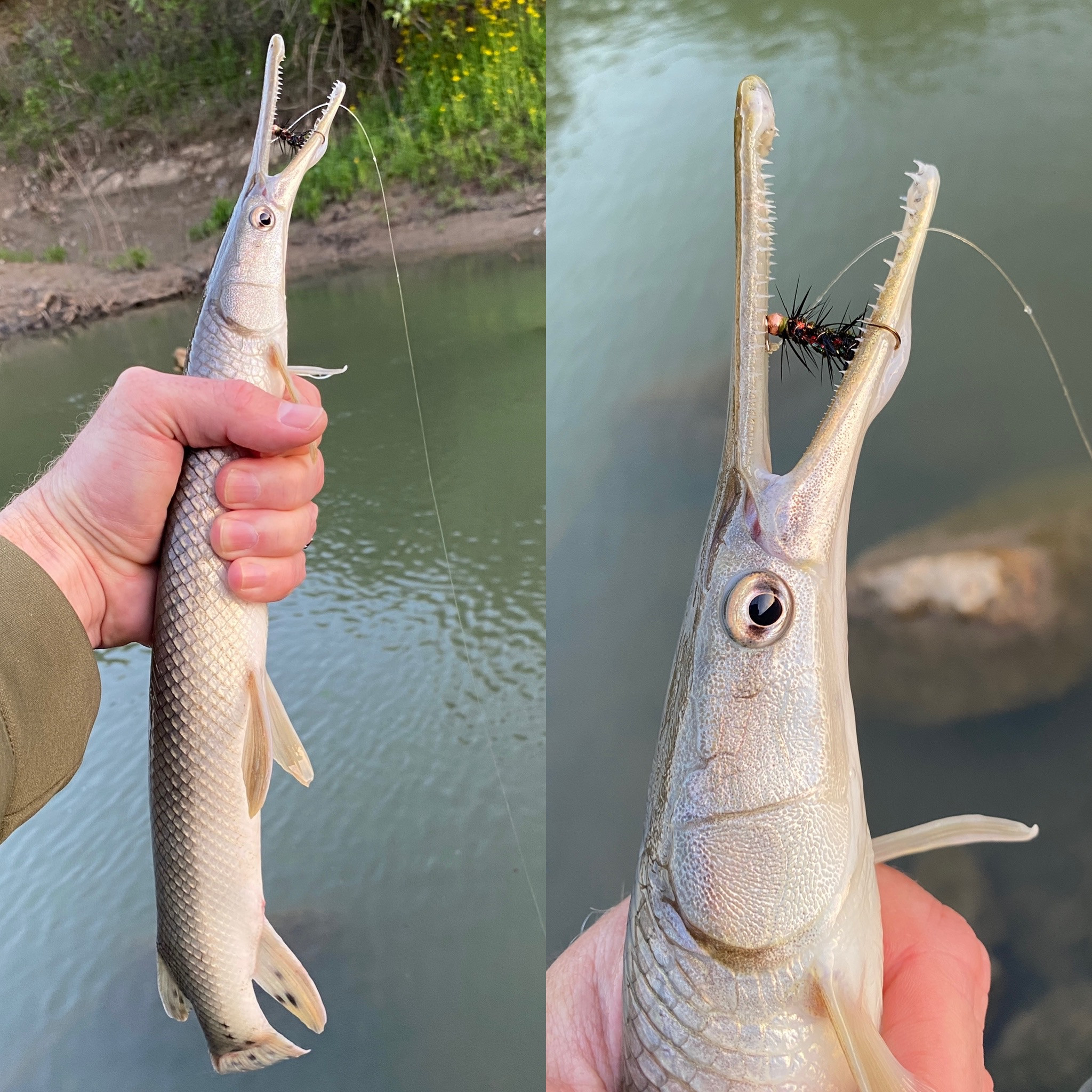
In my experience, Shortnose Gar seem to be the most willing to strike flies.  As long as you don't spook the fish, they will often strike multiple times, even after missed hooksets.  Although they will hit larger flies, I find I get more hookups with smaller flies / smaller hooks.  A size 10 woolly bugger is a great fly and size for most Shortnose Gar.  Small minnow and aquatic nymph flies also work very well.  Certainly these gar can be caught on larger flies, but it really helps if the gar can get the entire fly inside its mouth on the first gulp or grab.  Then that small hook has a better chance of hooking the fish.
Shortnose Gar on a Woolly Bugger

Shortnose Gar on Fly

I've only landed a couple Spotted Gar, and lost maybe a half-dozen others.  I feel they behave similarly, and will hit similar flies as a Shortnose.
Spotted Gar on Fly
Florida Gar...at least the ones I've caught, seem to be heavier-bodied and stronger fighting as compared to a Shortnose, but their snouts are pretty much identical to Spotted and Shortnose Gar.  They did seem less willing to strike during the day, but hit tarpon flies worked just below the surface at dusk.
Florida Gar on Fly

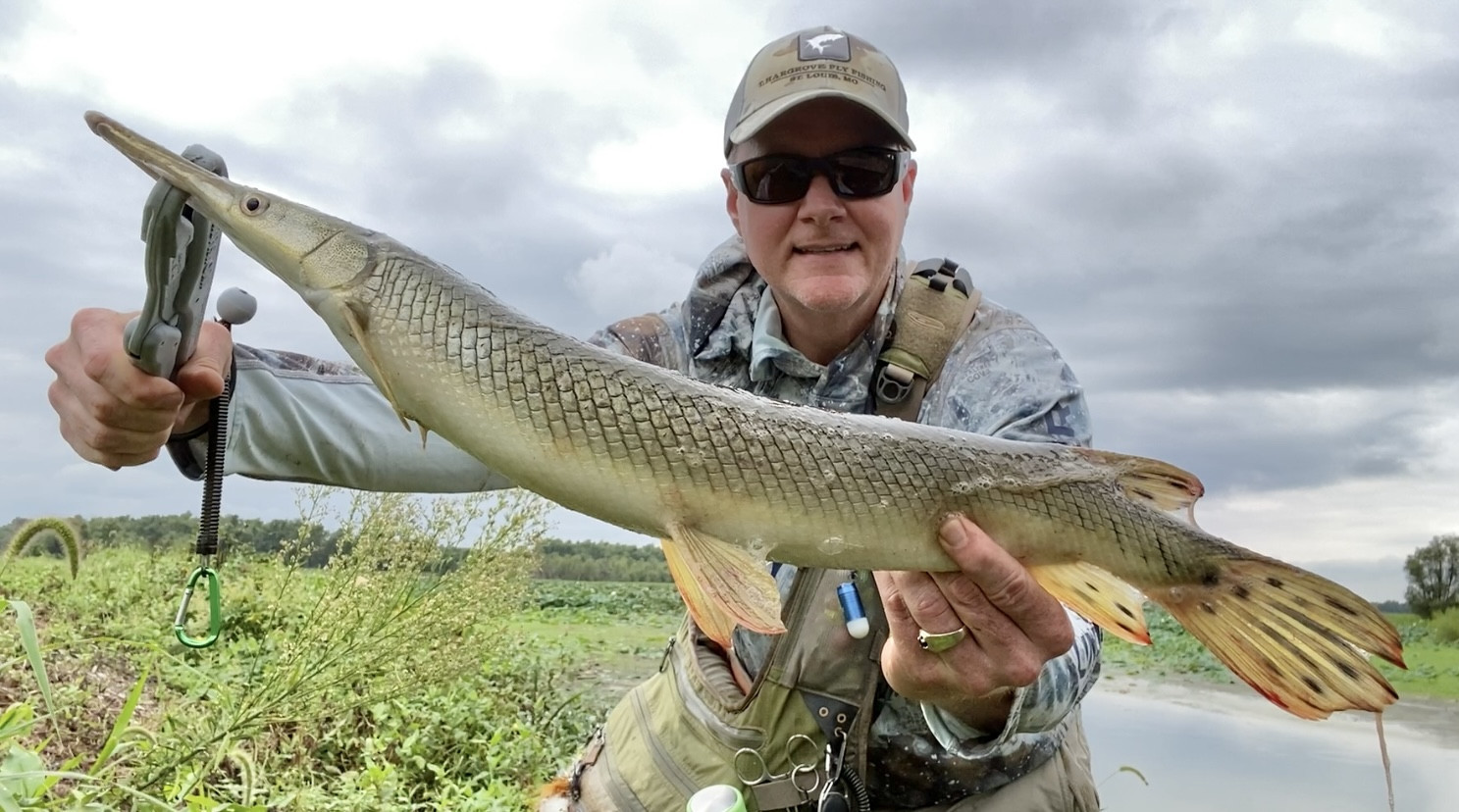
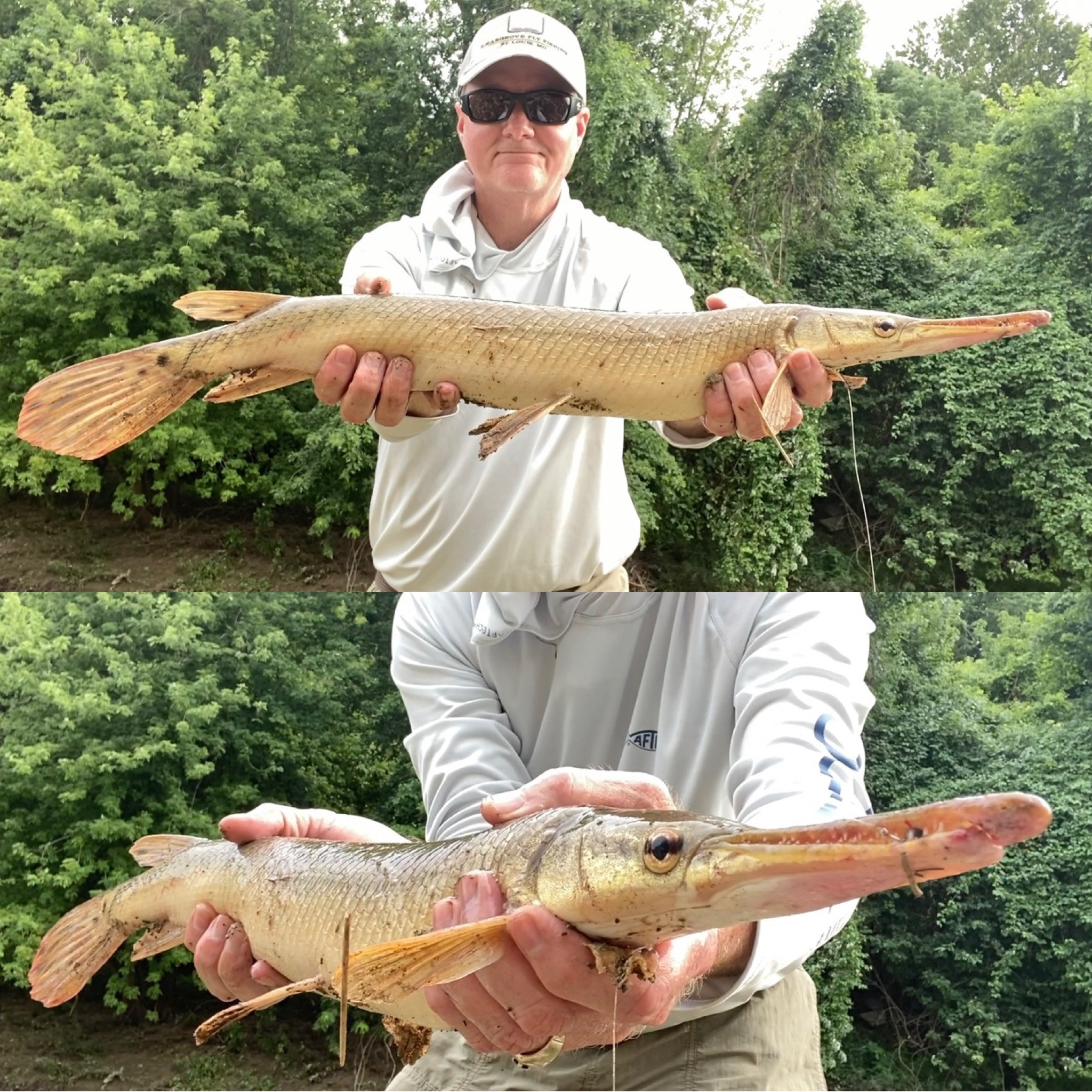
Longnose Gar will usually strike the same size flies as Shortnose, but like Florida Gar, there are many times when they just don't seem interested.  For bigger Longnose, I tied up a pattern I'd seen recommended online, that is an articulated fly with 2 super-sharp Gamakatsu B10S hooks... a #4 at the front, a #6 at the rear.  Overall fly length is about 4.5".  I tried it once late in the season this past year, and caught my biggest Longnose so far...a 47.5" beauty, approximate weight of over 10 lbs.
Longnose Gar on Fly

I prefer a 6wt fly rod for most Gar fishing, but will go to an 8wt or 9wt for bigger Longnose.  Those bigger Longnose do fight really well, and also the articulated flies cast easier with the heavier fly rods.   I use a weight forward floating line.  You want a strong tippet to help drive the hook home,  so 8-12 lb Fluorocarbon tippet is generally good.  You could go a bit heavier for the bigger Longnose.  Although Gar have a serious set of teeth, they are round teeth with points (like a walleye or bowfin), rather than flat-sided blade teeth like a pike.  You do NOT need steel leaders when flyfishing for these 4 species of Gar.

So, keep your hands and fingers as far away as possible from a Gar's mouth.  Use pliers or forceps to remove hooks.  Never "lip" a gar to hold it like a bass.  

Gar are very challenging and fun, and they are an extremely interesting and ancient-looking fish!  I really enjoy catching them on flies. They are a native fish that needs to be appreciated and protected.  Do some research, find some fish near you, and get after them!  Good luck! 

Here's a few pics of Gars I've caught while flyfishing:

Shortnose Gar on Fly

Shortnose Gar on Fly

Longnose Gar on Fly

Longnose Gar


Longnose Gar


Longnose Gar

Shortnose Gar

Longnose Gar


Shortnose Gar


Shortnose Gar

29.5" Shortnose Gar

30.5" Spotted Gar

Shortnose Gar

Florida Gar

Florida Gar
Addendum.... I caught a (small) Alligator Gar on fly in Louisiana in 2024!
Alligator Gar on Fly

Alligator Gar


Friday, February 21, 2014

Gar Fly Wannabe

If you've tried flyfishing for gar, you already know the obstacles which must be overcome.
In my area, there are primarily Shortnose Gar.  Within a couple hour's drive, I can get to a few Longnose Gar as well, but haven't made that trip yet.

Gar have tough bony, toothy jaws, with very little "meat" to sink a hook into.  There is some "meat" towards the inside of the back of the mouth between the lower jawbones.

This is why flies that entangle the teeth, such as rope flies, are a reasonably good option for catching gar.  It isn't fool-proof and you may typically only land 1 out of 3 good strikes.  I have landed gar on such flies.  One issue is that a 4"-6" rope fly casts like a wet sock on 5wt-6wt flyfishing gear.

This past summer, I tried a few smaller patterns (which had hooks) for gar, some floating, some sinking.  I hooked 5 or 6 gar.  Each one threw the hook when it jumped and violently shook its head.

A friend, Mark (his website:  http://www.backwatergallery.com/ ), has offered invaluable insight and tips.  He's a much more experienced and successful gar flyfisherman than I am!

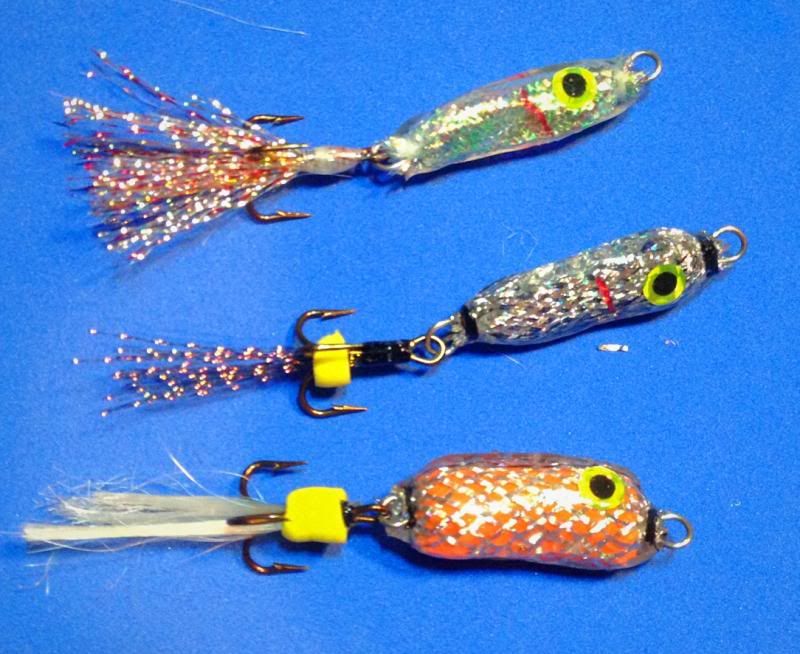
Based on some of his patterns, I came up with the flies below.  I am very hopeful that THESE will be THE FLY for my future gar flyfishing needs.  Please note...I HAVE NOT YET TRIED THESE OUT.  Well, I have tested them in a sink of water to see how they behaved/sank/floated.  I think these will be really good!
Cross your fingers, please.


Here's the promising features:
1.  Dressed #10 treble hook.  Hopefully at least ONE of the points of the treble hook will find something to grab onto in the gar's mouth.  The dressing provides some lift and appearance of lifelike movement...maybe some fish-attracting flash.

2.  Articulating hook connection to the rest of the fly.  Hopefully the gar will not be able to use the body of the fly to leverage the hook out!

3.  3/16" foam cylinder covering the hook shank.   This seems to improve the action of the fly and help it float (the wire underbody IS kind of heavy after all...as is the treble hook itself). The treble hook acts as a guard to help protect this exposed foam....but if it does get shredded, it can be replaced back at the tying bench.

4.  Wire underbody.  This way, there's no worries that the gar will sever the connection between the fly and hook, and it provides a fairly stiff underbody to tie the rest of the fly on.

5.  Foam body.  Sightfishing for gar is a visual game, so many fish/strikes will be near the surface.  Therefore, the fly needs to be there too.  Foam is the most reliable flotation method, IMO.  The top two flies in the picture above used a narrow strip of foam wrapped up the wire underbody.  The bottom one used size Large Rainy's Float Foam (slit down the side and then slid over the wire shank and CA gel-glued back together).  The top two don't provide QUITE enough flotation.  The middle one will ride on the surface as long as the fly is kept moving, but will sink when stopped.  This can be key to fishing pockets in weedbeds or flooded grass.  The bottom one floats even when stopped.  The action is really good.

6.  Foam protection.  Gar teeth will tear up a fly.  I covered the foam with mylar tubing to give it shine/flash and a fish scale appearance.  Next, I added stick-on eyes.  Then I coated all (even on the treble hook) thread wraps and entire body with Clear Cure Goo (a UV-cured epoxy alternative).  This covering is hard, smooth and slick.  A gar's teeth should NOT get hung up in it to prevent the hook from finding purchase in the fish's mouth.

All in all...this fly appears to incorporate MOST of the desireable features of an effective gar fly.  The last item one could try is some sort of soft but stiff material that could be used ahead of the hook so that it doesn't snag on sticks and flooded vegetation.

I can't wait to try these out!