

I love catching Channel Catfish on fly-fishing gear. They are so strong, and they love to run and take you to deeper water. Although I have specifically targeted Channel Catfish with flies with some success, it is more common that I will catch them while fishing for bass, bluegills and crappies. You may have read some of my previous blogs regarding catfish on flies from earlier this year.
I'm not an expert, but perhaps those wanting to try fly-fishing for catfish will find something useful from my experiences. With this in mind....
I have not tried fly-fishing for catfish in rivers or streams...all my catfish have been caught in ponds or large reservoirs.
First...fish somewhere that you know to have a very good population of Channel Catfish. Fish in the shallows (4' deep or less) at dusk, sunrise, after dark, or on overcast days. If you can SEE the catfish, that is a very good thing, however, either light conditions or water clarity will most likely prevent sight-fishing. Fish during the warm months...July-September seems to be when catfish are most active in the shallows in the Midwestern U.S. 5-weight to 7-weight fly rods and lines are adequate for catfish in still waters up to around 10 pounds. I use at least 3x tippet, but prefer 2x for catfish. I'll go even heavier if there are sharp rocks or trees/brush in the water along the shoreline I'm fishing.
Fish with fly patterns (mostly nymphs or streamers) that are tied on size 8 hooks or LARGER. You can try to match what you think the fish are eating. If they are chasing schools of shad in a reservoir, for example, a large white streamer/baitfish pattern can work well. Judging by the number of catfish I've caught on "metal" spinning lures such as spinners and blade baits, flash materials tied into your pattern will NOT deter a catfish.
 |
A white baitfish bucktail streamer pattern that has caught several large (24"-27") Channel Cats for me, when catfish were feeding on shad or bread. |
 |
| This 27" Channel Catfish was chummed in using hot dog buns, and then hit the white bucktail streamer. |
 |
| This 26" Channel Catfish was working a school of shad before it hit a white bucktail streamer |
On ponds, catfish might eat small bluegills, but an easier and more common meal would be large aquatic nymphs. If there are lots of rocks, catfish may be eating crayfish.
 |
| Jumpin' Catfish Nymph |
 |
| This 27" Channel Catfish was taken on the nymph shown above. |
In reality, I think Catfish will hit just about anything, especially if they think it is alive.

Catfish will scavenge, but the bigger they get, the more they become predators feeding living prey. If you don't know what the fish might be eating, try a simple Woolly Bugger. A white or grey Woolly Bugger is a fair imitation of a minnow. Olive, brown, or black Woolly Buggers can imitate large nymphs. Beadhead (or beadchain/barbell eye) tan or rust-colored Woolly buggers can imitate crayfish.
I watched a catfish rooting around the base of some algae/weeds in a pond. I dropped a weighted nymph to the bottom near the fish's head, and it turned and ate it. Another time, I was slowly swimming an unweighted wet fly, and saw a catfish literally touching the tail of the fly with it's lips...only to turn away at the last moment as the fly neared shore.
A couple years ago I was having remarkable success on bluegills and crappies with a yellow Boa Yarn Leech. I also caught a fair number of catfish on this pattern, as well as a silver version. I think the reason I caught so many catfish on it was simply because THAT is what was tied on my line at the time.
 |
| These are just two of many Channel Cats that I've taken on yellow Boa Yarn Leeches. |

One pond I fish has a good population of frogs and toads. I've caught several Channel Catfish at night on foam poppers I was using to try to catch bass!
 |
| The catfish above and below were taken on bass-sized foam poppers at night. |

Catfish have excellent sensory perception....good vision, but also very good sense of "smell" and vibration. Because of that, I think nymph patterns incorporating natural materials such as hair or feathers should work even better than the synthetic boa yarn material. I have caught catfish on Woolly Worms and Woolly Buggers in sizes 8 and 6.
As described in one of my earlier posts from this year, I tried "chumming bread" for catfish a couple times. It actually started when I was trying to chum bread for Grass Carp, but ended up catching some catfish instead. In situations where the catfish are eating bread, use a large fly pattern that looks like a hunk of bread. Actually, it doesn't even need to look like bread, it just has to be white and moving slowly through the area where the catfish are feeding on the (generally floating) bread.
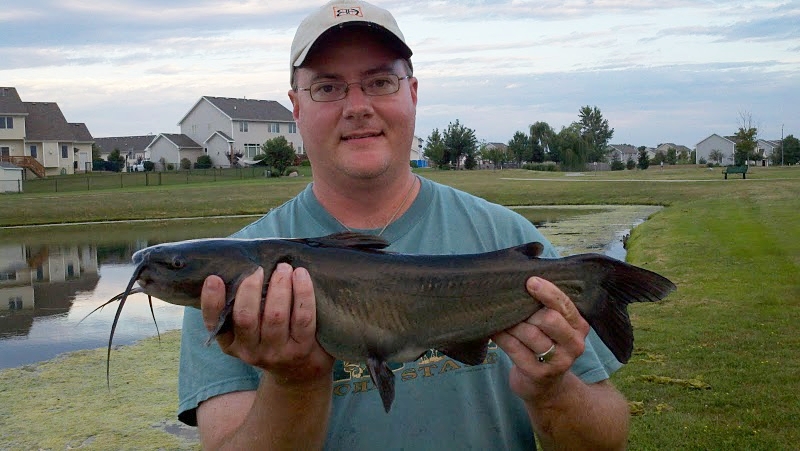 |
| This fat catfish hit a "bread fly" pattern. |
Feeding catfish are moving, so I feel it is wise to keep your fly pattern moving SLOWLY through the water. You can try slowly hopping weighted patterns on the bottom (especially if you are using a crayfish fly pattern), but a slow steady retrieve will also work just fine.
As I've mentioned, I think your chances of hooking into a Channel Catfish are best in the evenings or after dark...


 |
| Look at the BELLY on this kitty! |


As with every rule, there are exceptions...and many of my largest fly-rod catfish are taken during the middle of the day, even when it is bright and sunny:


 |
| The catfish above, a 31-incher, was caught during my lunch hour! |
So if you like seeing the backing on your fly reel now and then,

or just like fighting a fish that will put a big bend in your fly rod,

then you might want to give Channel Catfish at try!
 |
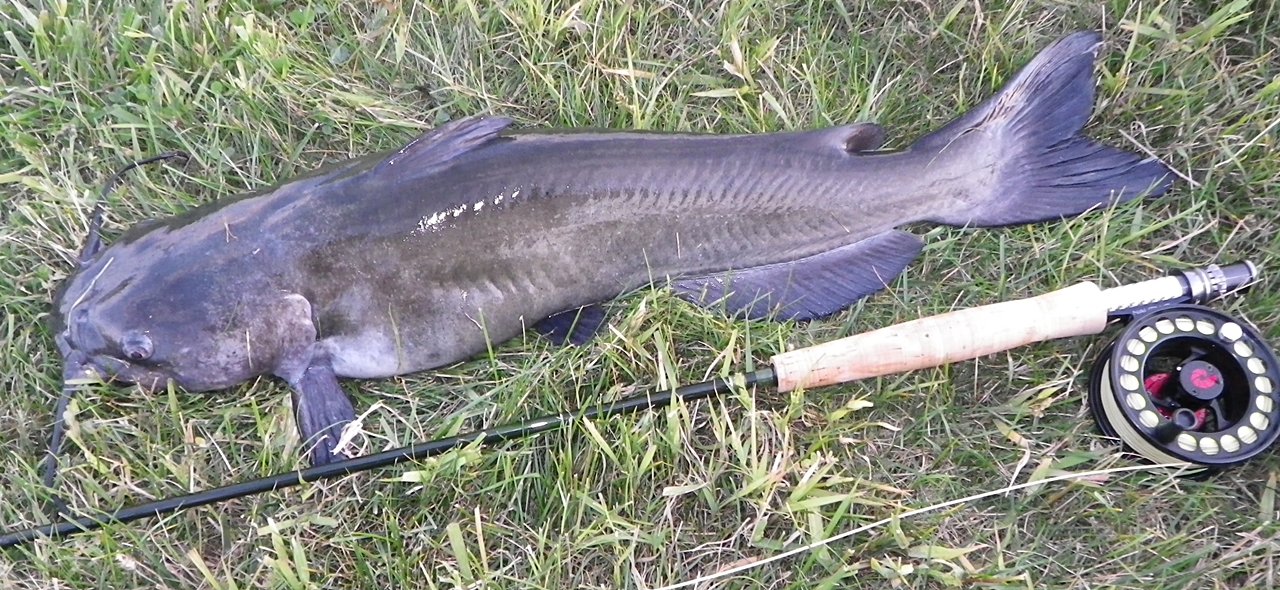
| This Channel Catfish, 31" long, hit a #8 silver/gray Boa Yarn Leech. |

